 News
News
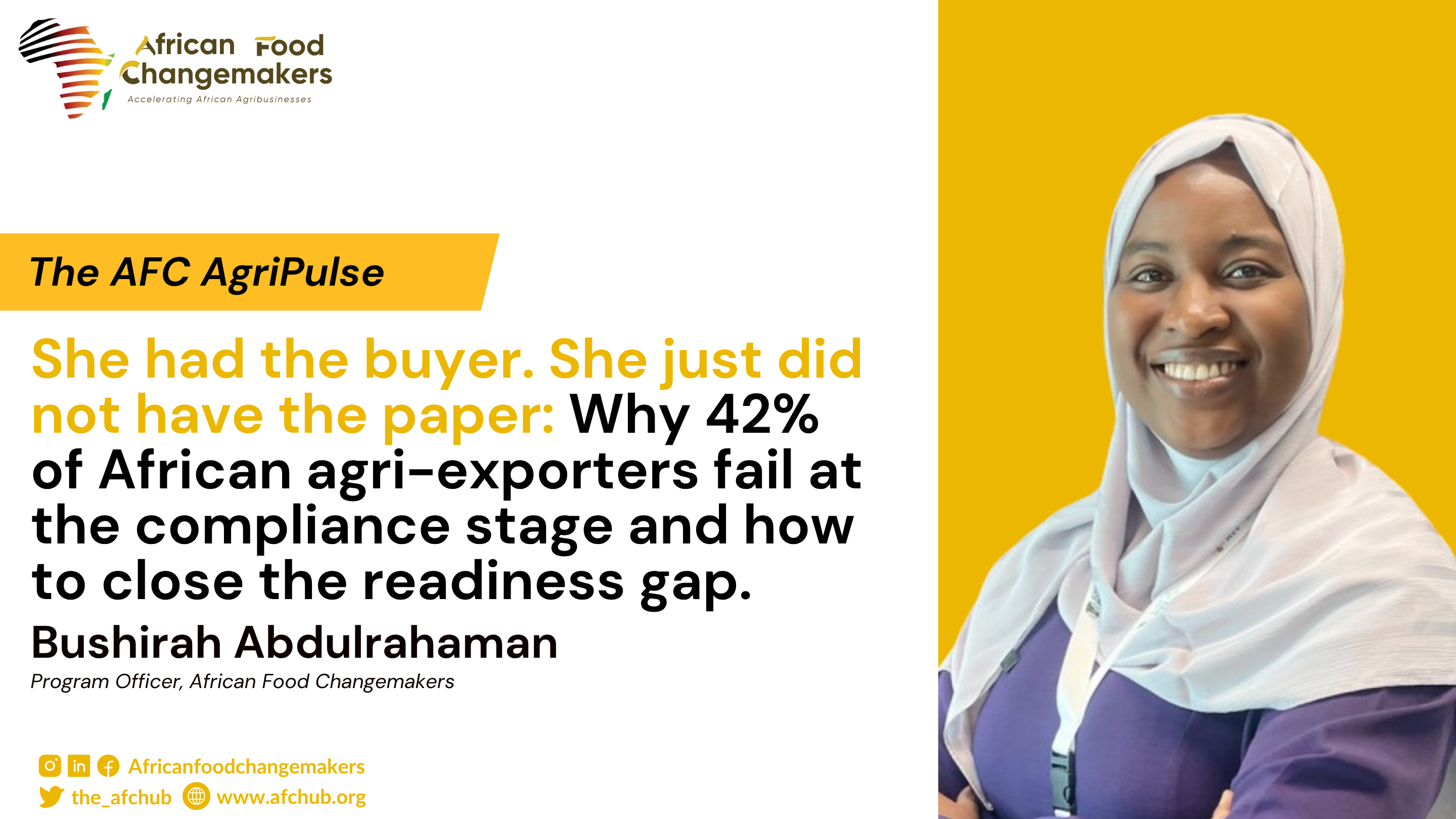
She had the buyer, but she just did not have the paper
Fatima had been waiting three years for a moment like this. Three years of early mornings at her processing facility. Three years of perfecting her spice blends and building a brand from scratch. Then, one Tuesday afternoon, the email arrived. A buyer in the Netherlands was interested in her dried ginger and turmeric. They wanted samples. They wanted pricing. They wanted to explore a partnership.
Fatima sent the samples. The buyer loved them. The conversations progressed. Then came the request that changed everything:
A proforma invoice. A phytosanitary certificate. A certificate of origin. Proof of export registration.
Fatima had a NAFDAC registration number. She assumed that was enough. She was unaware that domestic registration and export compliance were different requirements. She spent the next few days searching online, making calls, visiting offices, trying to navigate a process nobody had ever explained. She asked the buyer for more time, but the buyer moved on.
Fatima is not a real person. But her story represents hundreds of real African entrepreneurs.
During the African Food Changemakers (AFC) Open Export Series, more than 600 agrifood entrepreneurs from 50 countries shared similar concerns. They had products. They had ambition. Many had already attracted buyer interest. But one question kept appearing:
"What do I actually need before I can export?"
Africa Does Not Have an Export Problem. It Has a Readiness Gap.
For years, the dominant conversation around African exports has focused on market access. More trade agreements. More trade fairs. More matchmaking. These interventions matter. But they address only half the challenge. The bigger question is whether businesses are ready when those opportunities arrive.
The Readiness Gap is the distance between a business that wants to export and a business that is legally, operationally, and commercially prepared to do so. It exists in the missing certificate, the unclear documentation, the packaging requirement nobody explained, the quality standard a buyer expects but the producer was never prepared to meet.
The ambition is there. The opportunity is there. The missing link is readiness.
Fifty Countries. One Shared Gap.
When we asked participants to assess their export compliance readiness on a scale of one to five, here is what we learnt:
- 42% had no export documentation in place.
- 19% had limited documentation but were unsure of requirements.
- 18% had some documents, but significant gaps remained.
- 10% had most of the documents, but still needed to close gaps.
- 10% considered themselves fully export-ready.
Six in ten aspiring exporters were starting from near zero.
For every Fatima that loses a buyer, thousands of dollars in potential foreign exchange and local livelihoods are lost. Closing this gap is not just good business; it is economic development.
Export Readiness Is a System, Not a Single Document
Dr. Obiora Madu, a supply chain expert with over three decades of experience, challenged participants with a simple message:
"Most export deals fail because exporters prepare after receiving an order, not before."
The instinct to chase the buyer first and figure out compliance later is understandable. But it is why promising export opportunities collapse after the first conversation.
Export readiness requires preparation across five interconnected areas.
The 5 Pillars of Export Readiness
1. Business Compliance: Is your company registered with the appropriate export authority, not just your domestic tax office? Exporting requires specific permits and often a separate registration number. Without this foundation, nothing else moves forward.
2. Product Compliance: Does your product meet the specific quality and safety standards of your target market? For instance, if your dried ginger exceeds the EU's maximum residue limits for pesticides, no amount of relationship-building will save the deal.
3. Facility Compliance: Could your production facility pass a surprise buyer audit? Buyers don't just buy your product; they buy your process. GMP and HACCP are baseline expectations for any serious exporter.
4. Documentation Compliance: This is the paperwork graveyard where most deals die. Phytosanitary certificates, Certificates of Origin, and Proforma Invoices must be perfect and ready before the buyer asks. One missing stamp or incorrect tariff code can collapse a deal built over months.
5. Logistics Compliance: Logistics is not just freight forwarding. It is understanding Incoterms, cold-chain management, and customs clearance at both ends. A compliant product sitting at the port because the logistics paperwork was wrong is as useless as no product at all.
For many participants, this was the first time they had seen export readiness presented as a complete system rather than a confusing list of requirements.
Closing the Gap: What the Ecosystem Must Do
This is why the Open Export Series exists. By breaking down these five pillars, we help African agrifood entrepreneurs move from hoping to ready. The 97% satisfaction rating tells us we are onto something.
But here is our challenge to the wider ecosystem:
If donors, policymakers, and development partners continue to spend 90% of export budgets on trade fairs and only 10% on readiness training, we are setting entrepreneurs up for failure. We are handing Fatima a buyer's email, but not the paperwork to reply.
More trade fairs will not solve a missing certificate. More buyer introductions will not fix non-compliant packaging. More opportunities will not matter if businesses are not prepared when they arrive.
The Fatimas of this continent do not need more opportunities. They need to be ready when opportunities come.
Closing the Readiness Gap, one certificate, one audit, one training session at a time, may be the highest-leverage investment the African trade ecosystem can make.
The demand is already clear. A participant from Central Africa requested sessions in French. A fisheries exporter asked for guidance on animal-origin products. A participant from South Sudan asked if businesses in countries with weaker regulatory infrastructure could access certifications through neighboring countries.
These questions reveal something important: the gap is not caused by a lack of ambition. It is caused by information gaps, unclear processes, and limited access to practical guidance.
These are solvable challenges.
Your Turn: The Export Readiness Self-Assessment
Before you pursue your next buyer, ask yourself:
- Is your business registered with the appropriate export authority?
- Can you produce a phytosanitary certificate, certificate of origin, and commercial invoice?
- Could your production facility pass a buyer audit today?
- Does your packaging and labelling comply with your target market's requirements?
- Do you understand the Incoterms and logistics for your shipment?
If you answered no to two or more questions, you are not alone. You are where many exporters begin. And every one of these gaps can be closed.
And Fatima, whether she is in Lagos, Kampala, or Accra, deserves to know that the next time a buyer sends an email, she will not need two weeks of frantic scrambling.
Because through programs like the Open Export Series, and through a concerted effort from the entire ecosystem to prioritize readiness over matchmaking, we are ensuring that when opportunity knocks, she already has the paper.